Age, Sex, and Individual Differences
What counts as "normal" for HRV (heart rate variability) varies greatly from one person to the next. Age, sex, individual physiology, daily routine, and measurement conditions all matter. Feelmo therefore provides a display intended for reflection alongside your own past trend, not a ranking against other people. Detailed processing rules are not public. This page explains why individual differences matter, with sources.
What is the average HRV by age?
As a population, HRV is reported to decline gently with age (Umetani et al., 1998). But there is no shared reference value of the form "at this age, this number". The spread within an age band is often wider than the gap between bands, so an age-group average cannot tell you about one person.
Are there differences in HRV between men and women?
Studies of short-term HRV in healthy people report differences by sex on several measures (Voss et al., 2015). This too is a population tendency; sex and age cannot determine an individual's state.
Why "individual differences" matter so much
HRV captures variation in the intervals between heartbeats. Cardiac autonomic regulation contributes to HRV, but HRV is not a direct measurement of overall autonomic balance, health, stress, fatigue, or recovery.
That baseline level varies greatly from person to person. Feelmo therefore presents its Balance score (0–100) in the context of your own past pattern rather than as a population pass/fail line. A high or low score does not by itself mean calm, fatigue, recovery, illness, or permission to be active.
Read the score as an "expression," not a "grade"
Feelmo also presents six product companions—Genki, Odayaka, Futsuu, Fuan, Panku, and Tsukare. They do not mean that Feelmo detected the named emotion, fatigue, or health state, and their display rules are not public. For details, see The Six Companions.
A gentle decline with age
At the population level, many HRV measures tend to decrease with age. A study covering ages 10–99 reported an age-related decline across its sample (Umetani et al., 1998).
This is a population-level association, not a diagnosis or a rule that every older person must have a lower value than every younger person. Different age groups should not be judged against one universal HRV target.
HRV distributions by age and sex: a reanalysis of 1,121 public records
The Autonomic Aging v1.0.0 dataset on PhysioNet contains 1,000 Hz resting, supine ECG recordings from 1,121 healthy volunteers aged 18–92 (Schumann & Bär, 2022). The table and figure below are an unreviewed secondary analysis by Feelmo of that peer-reviewed public dataset. They are descriptive data, not medical reference limits.
Lead II was fixed in advance, and the first five minutes of each recording were processed consistently. To reduce automated beat-detection errors, records were excluded when two detectors disagreed on beat count by more than 10%; where two leads were present, lead I and lead II beat counts were also checked. Of 1,121 records, 1,044 passed all quality criteria. 1,021 people (394 male, 627 female) also had both an age band and the dataset's binary Sex field. The source did not measure gender identity. Values are median [first quartile–third quartile] in milliseconds (ms), not means.
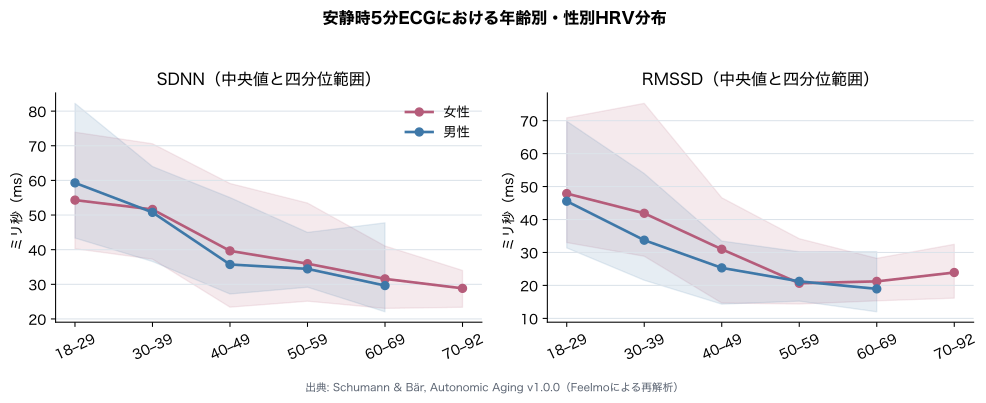
Figure: Points are medians; pale bands show the middle 50% (interquartile range). Values for men aged 70–92 are suppressed because only seven eligible records were available.
| Age | Male n | Male SDNN | Male RMSSD | Female n | Female SDNN | Female RMSSD |
|---|---|---|---|---|---|---|
| 18–29 | 215 | 59.3 [43.4–82.2] | 45.6 [31.4–69.8] | 442 | 54.3 [40.3–73.9] | 47.9 [33.0–70.9] |
| 30–39 | 71 | 50.8 [36.6–64.0] | 33.7 [21.6–54.0] | 64 | 51.6 [37.3–70.6] | 41.9 [28.8–75.2] |
| 40–49 | 48 | 35.7 [27.2–55.0] | 25.3 [14.3–33.5] | 41 | 39.6 [23.4–59.1] | 31.0 [14.7–46.6] |
| 50–59 | 36 | 34.5 [29.2–45.0] | 21.2 [15.2–30.2] | 29 | 36.0 [25.1–53.5] | 20.7 [14.4–34.2] |
| 60–69 | 17 | 29.6 [22.1–47.8] | 19.0 [12.0–30.3] | 24 | 31.6 [23.1–41.1] | 21.2 [15.3–28.2] |
| 70–92 | 7 | — | — | 27 | 28.8 [23.4–34.0] | 23.9 [16.1–32.5] |
The medians generally decrease with age, while values remain widely spread within the same age band. These medians are neither diagnostic cutoffs nor personal targets.
Cross-checks and sensitivity analyses
A separate peer-reviewed analysis of the same source dataset visually reviewed signals, selected a suitable five-minute segment toward the end of each record, and retained 1,026 people (Calderón-Juárez et al., 2023). Feelmo used an automated first-five-minute procedure, so this is not an attempt to reproduce the same retained sample.
Excluding nine records with more than 5% automated correction flags changed any age-by-sex median by at most 1.9 ms. A stricter analysis excluding 147 eligible records classified as “Barely acceptable” changed one small subgroup median by as much as 6.9 ms (male, age 60–69, RMSSD; n fell from 17 to 13). The broad age pattern remained, but small groups were sensitive to quality choices. Complete cell results, exclusion reasons, software versions, and input/output hashes are recorded in the manifest.
This is not an Apple Watch “normal range”
The table uses SDNN and RMSSD from standardized five-minute resting ECG. HealthKit stores intermittent Apple Watch SDNN measured with a different sensor, duration, posture, and timing. Do not compare an Apple Watch value directly with this table. If you review wearable data, prioritize your own longer-term records obtained under reasonably similar conditions.
Download the aggregate CSV · Analysis manifest and sensitivity results · Public analysis script
There are differences by sex, too
HRV has been reported to come out differently depending not only on age but also on sex. A study examining short-term HRV in healthy people found differences by sex in several indicators (Voss et al., 2015). The reference values for HRV themselves differ by age group and sex—this is something review articles on HRV research have also laid out (Shaffer & Ginsberg, 2017).
The conclusion is the same: group averages by sex and age cannot identify one person's current condition. When reviewing your own data, records obtained under reasonably similar conditions can provide context, but they do not diagnose a cause.
So Feelmo compares you with yourself
- Raw HRV commonly differs with age and between people. The Balance score is not a clinical scale for comparing someone in their 20s with someone in their 60s.
- Your own past trend can provide more relevant context than another person's average, but a change from baseline still cannot identify your condition or its cause (Umetani et al., 1998; Voss et al., 2015).
- The Home screen may include an in-product reference informed by your own past trend. Detailed comparison and display rules are not public, and it is not a medical reference interval.
Your baseline grows
HRV and daily records vary with sleep, exercise, seasons, life stage, and many other conditions. A baseline is not a fixed medical value. Avoid conclusions from one day and compare similarly collected records cautiously. Feelmo's baseline display rules are not public. See Your First Week and Your Baseline.
A note of caution
These are population-level trends. Your age or sex cannot determine your individual condition or health. Even if your HRV or score is on the lower side, that in itself does not mean anything is wrong. The table is a descriptive reanalysis of one public dataset, not a medical reference standard.
How Feelmo handles these individual differences
Feelmo is designed from the very start with these large individual differences in mind.
Feelmo uses proprietary on-device processing to summarize HRV-derived information available through Apple Watch / HealthKit and your own past pattern as a 0–100 Balance display. Processing details are not public. The score does not directly measure autonomic balance, emotion, fatigue, recovery, health, or whether you should be active. HRV itself can change with breathing, posture, time of day, movement, sleep, exercise, medication, illness, and measurement conditions.
In addition, Habit association patterns summarize observational relationships between habits you logged and Balance. Proprietary processing details are not public, and the display does not prove an effect or causal relationship.
Related: Balance score · What Is HRV (Heart Rate Variability) · Heart Rate and Resting Heart Rate · Habit Association Patterns.
References
- Umetani K, Singer DH, McCraty R, Atkinson M. Twenty-four hour time domain heart rate variability and heart rate: relations to age and gender over nine decades. Journal of the American College of Cardiology. 1998;31(3):593–601.
- Voss A, Schroeder R, Heitmann A, Peters A, Perz S. Short-term heart rate variability—influence of gender and age in healthy subjects. PLoS One. 2015;10(3):e0118308.
- Shaffer F, Ginsberg JP. An Overview of Heart Rate Variability Metrics and Norms. Frontiers in Public Health. 2017;5:258.
- Schumann A, Bär KJ. Autonomic aging—a dataset to quantify changes of cardiovascular autonomic function during healthy aging. Scientific Data. 2022;9:95. doi:10.1038/s41597-022-01202-y
- Schumann A, Bär K. Autonomic Aging: A dataset to quantify changes of cardiovascular autonomic function during healthy aging, version 1.0.0. PhysioNet. 2021. doi:10.13026/2hsy-t491
- Calderón-Juárez M, González-Gómez GH, Echeverría JC, Lerma C. Revisiting nonlinearity of heart rate variability in healthy aging. Scientific Reports. 2023;13:13185. doi:10.1038/s41598-023-40385-1
About the cited literature
The above presents general scientific background on individual differences in HRV; it does not prove the effectiveness of the Feelmo app itself. Feelmo is not a medical device, and it does not diagnose or treat. Nothing on this page should serve as a basis for medical decisions. If you have any symptoms that concern you, please consult a healthcare professional.