The short answer
Tentative words such as “maybe anxious” or “a little lonely” can help you check in with how you feel. Experiments have found changes in responses when emotions are put into words, but relief is not guaranteed. You do not need to keep searching for the perfect name. “I do not know yet” is something you can record too.
Key points
- Naming a feeling means describing how you feel now, not deciding your personality or a diagnosis.
- Brain activity, bodily responses and personally felt distress need to be interpreted separately.
- Choosing emotion words has been associated with both lower and higher distress under different experimental conditions.
- An everyday note can start with a few words or “maybe”. You can take a break when you do not want to put things into words.
Try placing a tentative word beside the feeling
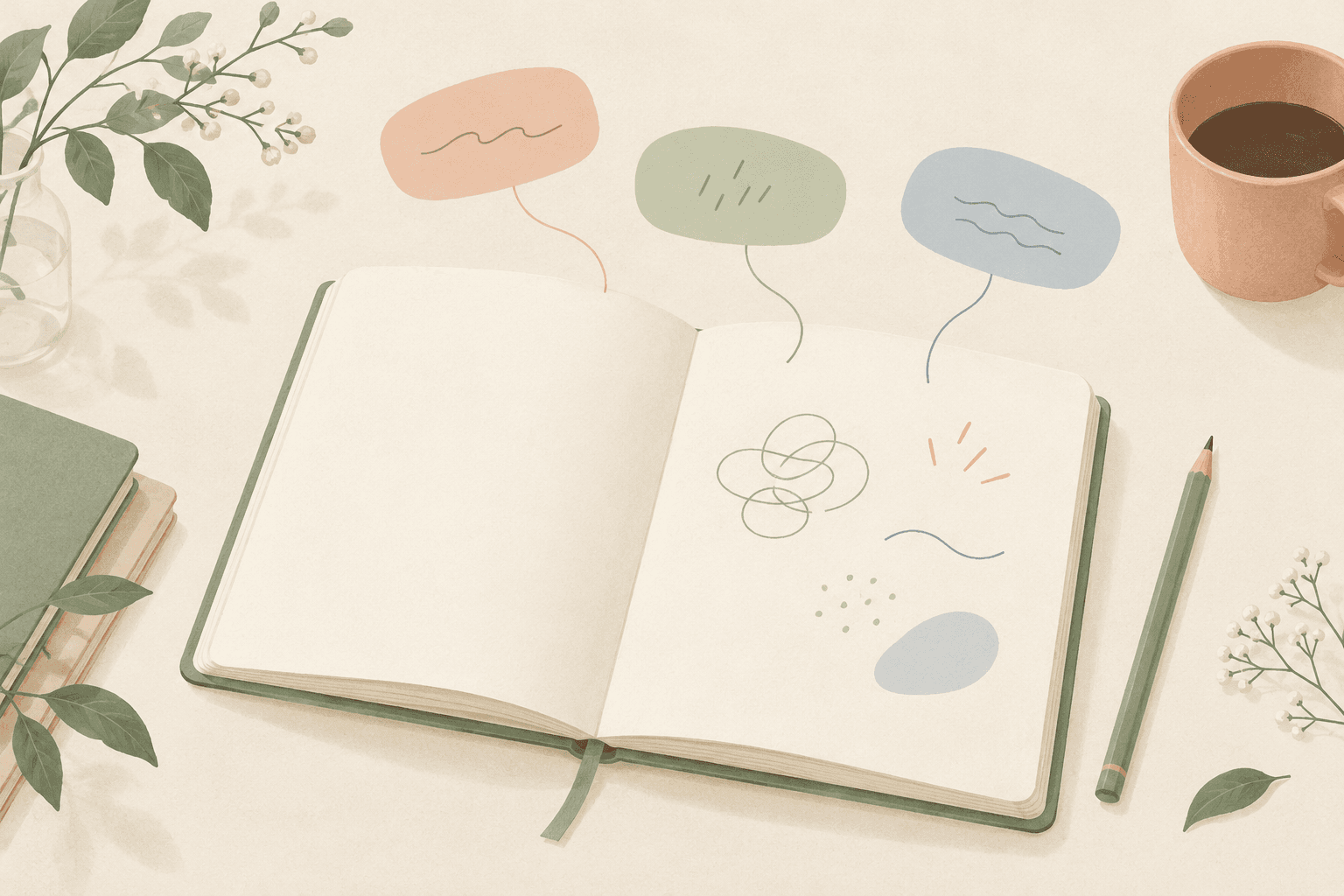
In psychology, putting emotional content into words is called affect labeling. Depending on the study, people may choose a word for the emotion on a photographed face or describe what they themselves are feeling.
In everyday life, it might mean adding “maybe I am anxious about tomorrow” or “perhaps I felt a little lonely without a reply” beside “I just feel off”.
You do not have to settle on one feeling. “I am looking forward to it, but anxious too.” “I was happy, but tired.” Different feelings can coexist in your note. A bodily state, such as tiredness, can also be a starting point.

Figure 1. Examples of tentative words for feelings and bodily states. This is neither an emotion assessment nor a research-validated procedure. You do not have to choose just one.
Writing “I felt anxious today” is different from deciding “I am a weak person”. The aim is to describe how you feel now. If different words come later, you can add them or revise what you wrote.
Differences in brain responses in an experiment with 30 adults
In a study published in 2007, 30 adults aged 18–36 completed several tasks while viewing photographs of faces showing emotions such as anger and fear. Brain responses were recorded using fMRI, which measures signals related to blood flow.
When participants chose a word matching the face’s emotion, responses in the amygdala, one of the brain regions involved in emotion, were smaller than during tasks such as choosing a name associated with the face’s gender (Lieberman et al., 2007).
However, the words mainly described emotions expressed by photographed faces. This was not an experiment in journaling about personal worries. A smaller response in one brain region also does not establish an equivalent reduction in felt distress or the treatment of a mental health problem.
The study suggests that responses can change when emotional content is handled through language. What changes with everyday journaling needs to be investigated separately.
A bodily response and feeling afraid are different things
Other research has involved naming one’s own feelings. In a 2012 experiment, 88 people with a strong fear of spiders were divided into four groups to compare ways of facing a live spider: labeling feelings, reinterpreting the situation, directing attention elsewhere, or exposure without those additions.
One week later, when facing another spider in a different setting, the affect-labeling group showed a smaller skin conductance response than the other groups. Yet no greater improvement over the other groups was found in their self-reported fear (Kircanski et al., 2012).
Skin conductance measures electrical changes in the skin associated with processes such as sweating. It does not directly measure the fear a person feels.
| Measure | Result for the affect-labeling group |
|---|---|
| Skin conductance response | A smaller response than in the other groups |
| Self-reported fear | No greater reduction than in the other groups was detected |
Bodily responses and felt distress need to be considered separately. This experiment does not mean that putting feelings into words will always make fear go away.
These findings also came from an experiment involving exposure to a feared object. They do not establish the effects of brief everyday journaling or Feelmo. You do not need to copy the procedure by forcing yourself to face something frightening alone.
Does putting it into words always bring relief?
Changes do not always go in the same direction.
In Experiment 2 of a 2022 study, 79 participants viewed unpleasant pictures and chose between two words describing how they felt. The comparison task did not involve choosing emotion words.
For high-intensity pictures, participants reported less distress during affect labeling than during the comparison task. For low-intensity pictures, they reported more distress during labeling (Levy-Gigi and Shamay-Tsoory, 2022).
The task used pictures and pairs of words supplied by researchers. We cannot assume the same results for an everyday sense of feeling off, or use distress intensity alone as an automatic rule for whether to write.
What matters is that naming feelings may be useful in some situations and less useful in others. If writing makes you feel worse, you do not have to pressure yourself to find a more accurate word.
You do not need to collect lots of words
When trying to understand your feelings, you may want to search for increasingly precise words. But writing in detail does not have to be the goal every time.
In an experiment with 82 people who imagined themselves in an emotional vignette, those assigned to describe emotions with fewer words reported greater emotional clarity than those using many words (Vine et al., 2019).
The study examined immediate emotional clarity and plans for subsequent coping. It did not establish long-term journaling benefits or treatment effects. Nor did it show that exactly one word is always best.
For today’s note, “maybe a little anxious” might be enough to stop there for now.
If you write, try separating three things
The following is an everyday example, not a direct reproduction of an experimental procedure. Briefly record whichever parts feel manageable.
Choose just one event
“There is no reply yet to the message I sent.” Start with what happened. “They dislike me” is a thought that came to mind, rather than the event itself. You can record that thought too, while keeping it separate from what you currently know as fact.
Add a bodily sensation, if you notice one
“My shoulders are tense.” “My stomach feels heavy.” If only a bodily sensation comes to mind, you can start there. That sensation alone does not determine a particular emotion or illness.
Try a word that seems close
“Maybe anxious.” “A little lonely.” “Perhaps I was angry.” Add words that seem close without trying to get them exactly right. “I do not know yet” or “both anxious and lonely” are fine too.

Figure 2. An everyday example to try. Event, bodily sensation and feeling words do not all have to be present. This note does not prove someone else’s intentions or the cause of a feeling.
“No reply yet. My shoulders are tense. Maybe anxious.”
What you do next is a separate choice: rest, return to another task, talk to someone you trust, or close the journal without deciding anything. Naming a feeling does not oblige you to find an immediate solution.
In Feelmo’s journal, you can leave a brief note in your usual words. Paper or another notes app is fine too.
Days without words can stay that way
“I do not really know today.”
“A lot happened, and I do not want to write right now.”
Those are records of how you are now, too. You can also close the journal without writing, or add different words later.
If your feelings do not change after writing, that alone is not a failure. Naming a feeling, resolving an event and reducing distress are separate things.
If writing keeps your thoughts racing or brings back painful memories strongly, you can stop partway through. Detailed entries and daily writing do not have to become homework you set yourself.
If distress persists, do not rely on journaling alone
Trouble sleeping, changes in appetite, or difficulty with usual work or chores: if such distress persists or worsens, seek advice from a healthcare professional rather than relying on notes alone. NIMH also advises considering how symptoms affect everyday life and talking to a healthcare provider if self-care does not help or symptoms worsen.
You do not have to decide that all physical discomfort is emotional. If physical symptoms concern you, you can seek advice about those symptoms in their own right.
You need not wait until you can explain everything clearly. “I just feel unwell, and it is hard to explain” is a place to start.
References
- Lieberman MD, et al. (2007). Putting feelings into words: Affect labeling disrupts amygdala activity in response to affective stimuli — Psychological Science, 18(5), 421–428. DOI: 10.1111/j.1467-9280.2007.01916.x
- Kircanski K, Lieberman MD, Craske MG. (2012). Feelings into words: Contributions of language to exposure therapy — Psychological Science, 23(10), 1086–1091. DOI: 10.1177/0956797612443830
- Levy-Gigi E, Shamay-Tsoory S. (2022). Affect labeling: The role of timing and intensity — PLOS ONE, 17(12), e0279303. DOI: 10.1371/journal.pone.0279303
- Vine V, Bernstein EE, Nolen-Hoeksema S. (2019). Less is more? Effects of exhaustive vs. minimal emotion labelling on emotion regulation strategy planning — Cognition and Emotion, 33(4), 855–862. DOI: 10.1080/02699931.2018.1486286
- My Mental Health: Do I Need Help? — National Institute of Mental Health (NIMH). Accessed 27 October 2026.