The short answer
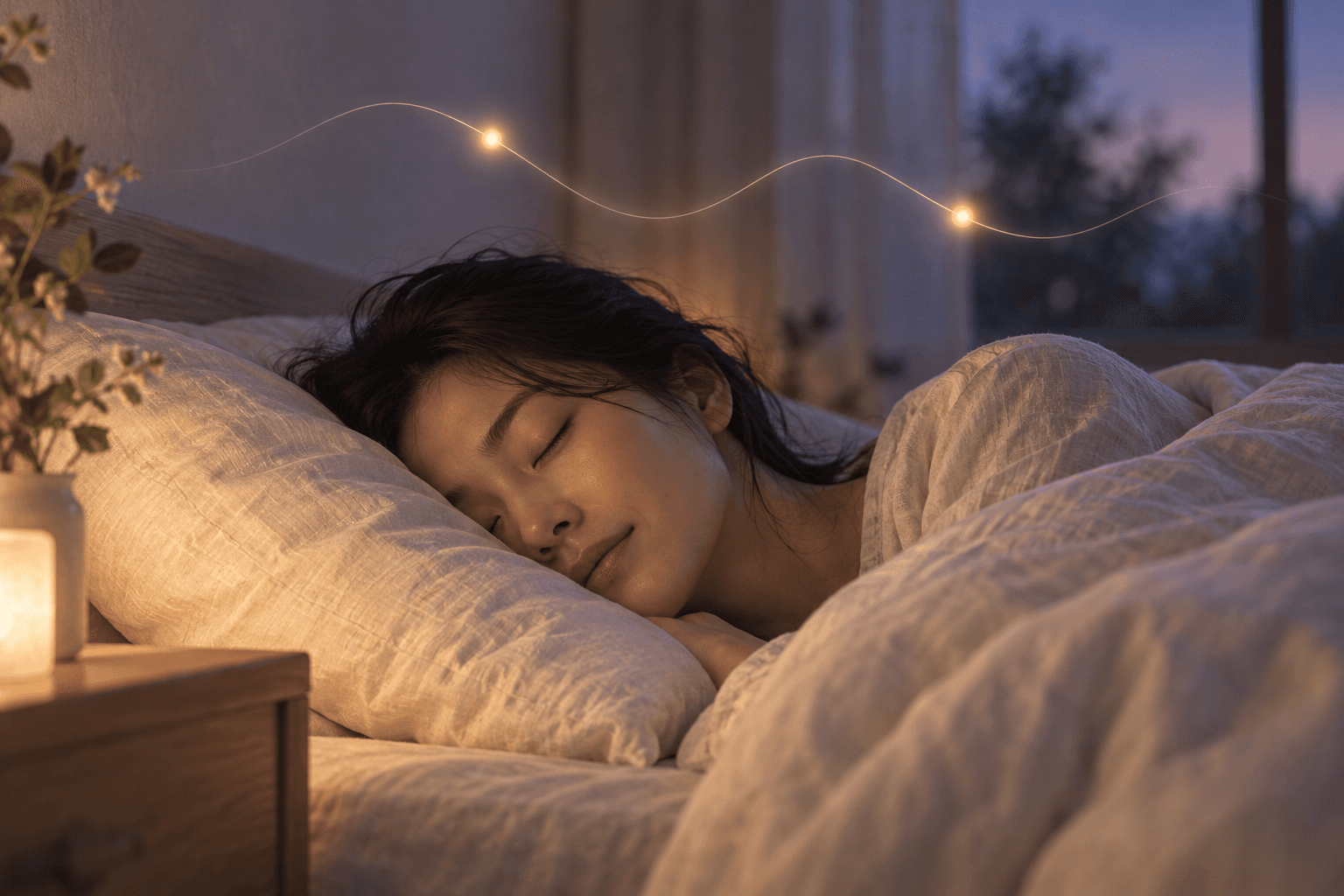
Researchers are testing whether sounds timed to sleeping brain waves can help retain learned information. The technique is called closed-loop auditory stimulation. Some experiments improved recall of material learned before sleep. Results differ across studies, however, and we cannot yet say that using it at home improves everyone’s memory. Changes in brain waves and benefits felt the following morning need to be assessed separately.
Key points
- Researchers measure sleeping brain waves and time brief sounds to their rhythm
- The main question is whether information learned before sleep is retained
- A change in brain waves does not necessarily improve memory-task performance
- Home studies are progressing, but everyday benefits still need further testing
Sleep continues to support memory
A new word. Something you studied. A work procedure you were shown for the first time.
Sleep helps support learning and build lasting memories. The US National Heart, Lung, and Blood Institute also describes sleep as important for learning and long-term memory formation (NHLBI, “Why Is Sleep Important?”).
One focus of research is the slow brain rhythm that appears during non-REM sleep.
Periods of higher nerve-cell activity alternate with quieter periods. Electrodes placed on the head record this repeating activity as brain waves.
Could an external intervention timed to this rhythm support brain activity involved in memory? That question has led to experiments using brief sounds (Harlow et al., 2023).
The key is when the sound arrives
The process can be outlined in three steps.
Measure brain waves during sleep
Electrodes capture the sleep state and the brain’s current rhythm.
Choose the moment to deliver sound
The measured rhythm is used to determine when a brief sound should arrive.
Play the sound and keep measuring
Brain-wave recording continues after the sound, providing information for the next intervention.
Using measured information to guide the next intervention creates a feedback loop. This gives the technique its name: closed-loop auditory stimulation, or CLAS.
In a landmark 2013 study, a comparison involving 11 people examined nights with sounds timed to brain rhythms and nights without sound.
The sounds were short bursts of pink noise lasting about 0.05 seconds. With stimulation, slow brain-wave activity increased and participants better recalled word pairs learned before sleep. A separate experiment with different timing did not find the same effects (Ngo et al., 2013).
The distinctive feature is measuring the rhythm to decide precisely when to deliver each sound.
What happens over several nights?
Research is expanding from a single night to repeated use.
In a study published in 2024, the same participants experienced three nights with sound and three without, in separate weeks. They learned before sleep, and researchers compared subsequent performance.
The study recruited 28 people, but missing data and technical issues meant that the main learning-task analyses used data from 18.
Those analyses reported greater improvements on language and other learning tasks in the sound condition (Clark et al., 2024).
This is encouraging, but the study involved a small sample and specific tasks. It cannot establish the same benefits for everyday forgetfulness or long-term use.
The paper also discloses that the device manufacturer provided equipment and technical support, and that one author was a scientific adviser to the company.
Other studies did not find clear benefits
Reading a successful experiment may make the technology sound well established.
Analyses bringing several studies together help put individual findings in context.
A 2021 analysis combined 10 studies comprising 11 experiments and 177 healthy participants. The overall result did not establish a statistically clear memory improvement. Some conditions showed benefits, but the findings as a whole required caution (Wunderlin et al., 2021).
A separate 2023 analysis reported a trend toward smaller memory-task effects in later publications. It also identified questions about sample sizes and the reliability of tasks measuring memory change (Harlow et al., 2023).
Researchers are using repeated experiments to establish whether a promising possibility can become a dependable benefit.
Does it also help in your own bedroom?
Whether laboratory findings carry over to an ordinary bedroom matters for everyday use.
A study appearing in a 2026 journal issue tested one night at home in 34 participants. One group had brain waves recorded; the other received sound while recording continued.
The findings separated into two parts.
Sound increased the amplitude of slow brain waves. However, improvements were not found on memory tasks or a task requiring sustained attention and responding (Baldassarri et al., 2026).
The limited sample might have missed a small effect. Nevertheless, the findings show why changes in brain waves and benefits on actual tasks must both be measured.
They also cannot be reinterpreted as evidence of more time in deep sleep or feeling more refreshed the following morning. Those are different outcomes.
Head-worn equipment now allows researchers to record brain waves and deliver sound at home. The next question is how much this can help in daily life.
Would playing sleep sounds do the same thing?
Rain or ocean waves: perhaps you already play sounds at bedtime.
The studies described here measured brain waves in real time and adjusted the timing of brief sounds. They do not establish the same memory benefit from playing a sleep soundtrack all night.
The material studied was learned before sleep. These findings also do not show that simply hearing audio while asleep teaches a new language or new knowledge.
When reading an article or product description about this technology, three questions can help.
- Who was studied? Are results from a small group of young adults being extended to a much wider population?
- What changed? Brain waves, memory-task scores, or the person’s experience of sleep?
- Where and for how long was it used? One laboratory night, or repeated nights at home?
“Helps sleep” can describe very different findings. Knowing what was actually tested makes the possible benefits clearer.
Technology that responds to sleep
Measure the brain’s state, then time a sound to that moment.
What makes this research interesting is a device adjusting its intervention to the sleeping person’s state.
How much does it help everyday memory and daily life? Who might benefit, and after how many nights? What happens with continued use? Those questions remain open.
How far can tiny sounds support the sleeping brain’s own work?
Researchers are gradually carrying that question from the laboratory into the familiar bedroom.
References
- How Sleep Works — Why Is Sleep Important? — National Heart, Lung, and Blood Institute (NHLBI)
- Ngo HVV, Martinetz T, Born J, Mölle M. (2013). Auditory closed-loop stimulation of the sleep slow oscillation enhances memory — Neuron, 78(3), 545–553. DOI: 10.1016/j.neuron.2013.03.006
- Clark VP, et al. (2024). Closed-Loop Auditory Stimulation (CLAS) During Sleep Augments Language and Discovery Learning — Brain Sciences, 14(11), 1138. DOI: 10.3390/brainsci14111138
- Wunderlin M, et al. (2021). Modulating overnight memory consolidation by acoustic stimulation during slow-wave sleep: a systematic review and meta-analysis — Sleep, 44(7), zsaa296. DOI: 10.1093/sleep/zsaa296
- Harlow TJ, Jané MB, Read HL, Chrobak JJ. (2023). Memory retention following acoustic stimulation in slow-wave sleep: a meta-analytic review of replicability and measurement quality — Frontiers in Sleep, 2, 1082253. DOI: 10.3389/frsle.2023.1082253
- Baldassarri A, et al. (2026). The Effect of Closed-Loop Auditory Stimulation on Memory Consolidation and Sleep Physiology in an Ecological Setting — Journal of Sleep Research, 35(3), e70247. DOI: 10.1111/jsr.70247 (Published online: 2025-11-12)
More in the Feelmo guide
Review your sleep records