The short answer
You do not need to keep checking the time or previous scores when you cannot sleep. A sleep score is an estimate for reviewing last night the next morning. First note how rested or sleepy you feel, then look at the three components and roughly a week’s pattern. If numbers make you more anxious, you can stop looking at the display or pause tracking for a while.
Key points
- One low score cannot identify the cause of anxiety or diagnose illness
- Apple Watch combines sleep duration, bedtime consistency and overnight awakenings in its sleep score
- Wrist-worn devices have measurement errors and are not equivalent to a clinical sleep test
- If numbers increase worry, temporarily not checking or tracking is an option
- In the morning, review your experience, then the three components, then roughly a week’s pattern
You do not need to think about scores while you cannot sleep
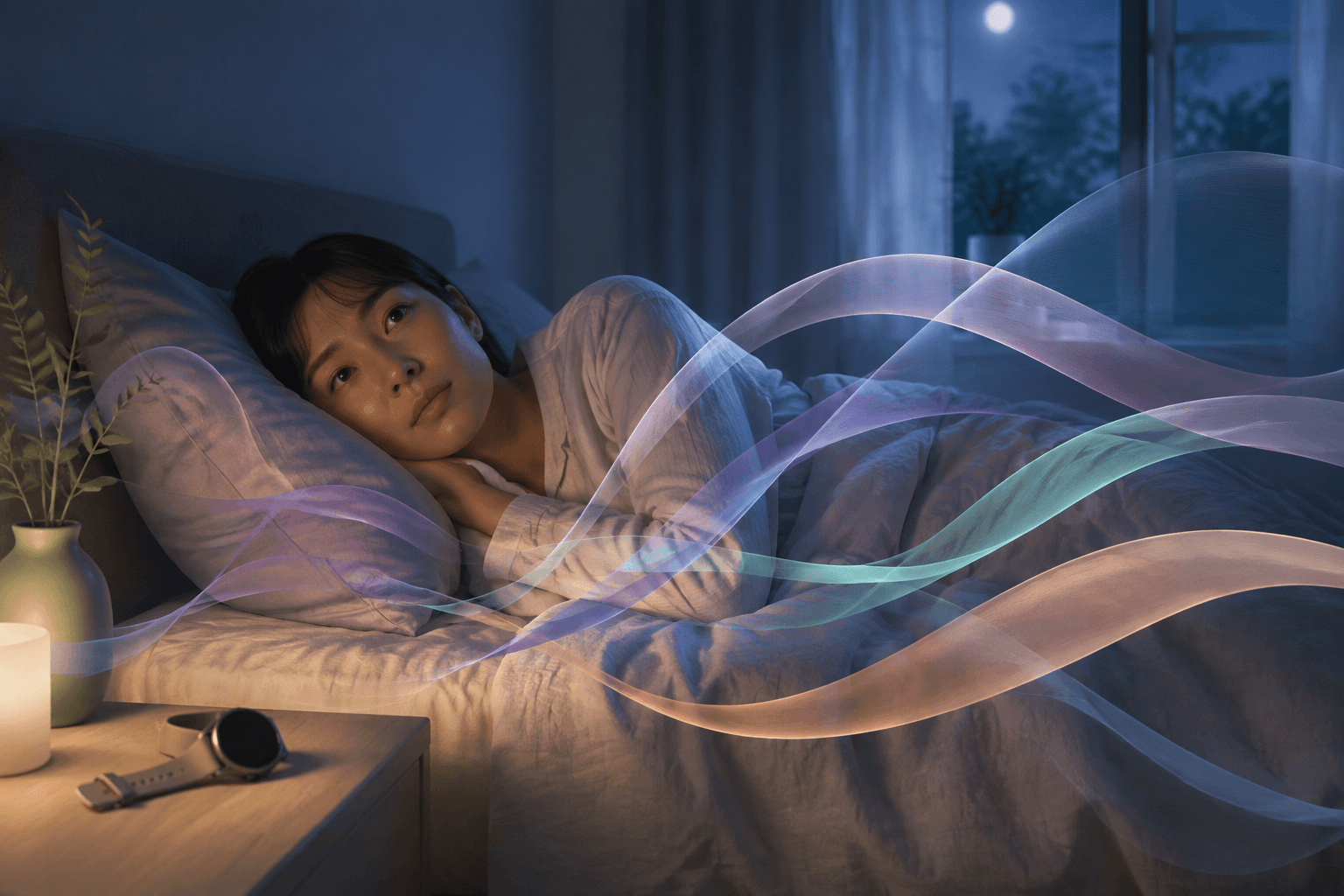
Apple Watch shows the sleep score after you wake. It is not a current score changing throughout the night. Yesterday’s score cannot tell you whether you will sleep tonight.
The harder you try to fall asleep quickly, the more you may notice the clock and bodily sensations and worry about how few hours remain. Insomnia research suggests this worry and heightened attention to sleep can prolong wakefulness. Being unable to sleep is not a failure to try hard enough.
Anxiety and insomnia can affect each other
Strong anxiety can make it harder to fall asleep. In turn, repeated sleepless nights can increase worry about the next day. Reviews of multiple studies suggest that insomnia, anxiety and low mood may be related in both directions.
This does not mean everyone with anxiety is unable to sleep, or one sleepless night causes an anxiety disorder. These are patterns observed across groups. A sleep score alone cannot determine your mental state or future.
What a sleep score can and cannot tell you
Apple’s sleep score is out of 100: 50 points for duration, 30 for consistency of sleep onset and 20 for the number and duration of awakenings. Bedtime consistency uses sleep-onset times from the previous 13 days.
This is Apple’s own way to summarise one night of sleep. It does not directly measure anxiety, the content of your thoughts, next-day concentration or whether you have an illness. HRV and the proportion of deep sleep are not included in Apple’s published point allocation.
- What it shows: a combined evaluation of estimated duration, bedtime consistency and interruptions
- What it cannot show: the cause of anxiety, how much the brain rested, next-day ability or a sleep-disorder diagnosis
- A useful comparison: your recent pattern on the same device
- A difficult comparison: scores from another device or app, relatives or social media
A score can differ from the feeling that you did not sleep
Wrist-worn devices estimate sleep, wake and sleep stages from movement and wrist sensors. Detailed clinical sleep tests instead record brain waves, eye movements, muscle activity and other signals. Different measurement methods do not produce identical results.
A 2025 analysis combined 24 studies involving 798 people. Wrist-worn devices estimated sleep time about 17 minutes shorter on average than detailed sleep testing. Sleep efficiency, the proportion of time in bed spent asleep, was about 4.7 percentage points lower on average.
These are averages across different devices and participants. They do not mean your Apple Watch is wrong by 17 minutes every night. Errors vary with the model and that night’s sleep.
Some days you may have a high score but feel unrefreshed, or a low score but function better than expected. Numbers and personal experience reflect different aspects of sleep. Neither has to be the only correct answer.
Chasing a good score can become distressing
“Orthosomnia” is sometimes used to describe increasing worry about sleep while trying to perfect sleep data. The term first appeared in a report describing three patients. It is not a formal diagnosis, nor proof that everyone who uses a tracker develops insomnia.
The World Sleep Society’s 2025 recommendations advise against competing with yourself or others on sleep scores and suggest looking at averages over roughly a week rather than one night. If tracking increases anxiety, taking a break is an option.
Three things to try if you cannot sleep tonight
Stop checking the clock
If looking makes you feel more pressured, turn your watch or clock out of view. Instead of calculating how many hours remain, leave the score until morning.
Ease off trying hard to sleep
If you are not sleepy and feel increasingly tense in bed, get up for a while. Do something quiet and unstimulating, such as reading a paper book in a dim, calm place, and return when sleepiness comes back. You do not need to time the minutes.
Choose one calming activity
Try one low-effort option that suits you: quiet reading, gentle sounds or comfortable breathing. Breathing techniques and changes to daily habits alone do not necessarily resolve persistent insomnia.
Five steps for reviewing the next morning
Write how you feel first
Before checking the score, briefly note feeling rested, sleepiness, anxiety and physical condition. Writing first can help keep the score from shaping your initial impression.
Look at the three components before the total
Review duration, consistency of sleep onset, and the number and length of awakenings. The total alone does not show what differed from usual.
Check whether tracking was complete
Check when you wore the watch, battery charge, wrist fit and changes in your sleep schedule. Missing records alone cannot determine sleep quality.
Review roughly a week, not one night
Look at the pattern on the same Apple Watch alongside your experience, caffeine, alcohol, health and bedtime and waking time. One coinciding change does not establish a cause.
Pause tracking if it increases worry
If each score feels distressing or you fear the numbers before bed, you can avoid the display for a few days, take a break from wearing the watch or consult a healthcare professional.
Seek help according to difficulties, not scores
If trouble sleeping, feeling unrefreshed or marked daytime sleepiness persists and affects work, school, chores or driving, seek medical advice regardless of the score. The same applies to loud snoring, pauses in breathing during sleep or strong discomfort in the legs.
Cognitive behavioural therapy for insomnia (CBT-I) is a recommended first treatment for persistent insomnia. It works gradually on thoughts and habits around sleep with professional support. Avoid drastically restricting sleep time on your own.
Strong anxiety or low mood that makes daily life difficult also warrants support. If distress is so severe that you want to harm yourself, do not wait for a scheduled appointment: use local medical or emergency support or an official advice service.
References
- View your sleep score on Apple Watch — Apple Watch User Guide
- A Systematic Review Assessing Bidirectionality between Sleep Disturbances, Anxiety, and Depression — Sleep
- A cognitive model of insomnia — Behaviour Research and Therapy
- Performance of consumer wrist-worn sleep tracking devices compared to polysomnography — Meta-analysis — Journal of Clinical Sleep Medicine
- Orthosomnia: Are Some Patients Taking the Quantified Self Too Far? — Journal of Clinical Sleep Medicine
- World Sleep Society recommendations for wearable consumer sleep trackers — Sleep Medicine
- The European Insomnia Guideline: an update on diagnosis and treatment of insomnia 2023 — Journal of Sleep Research
- Sleep Guide for Health Promotion 2023 — Japan’s Ministry of Health, Labour and Welfare
More in the Feelmo guide
Reading sleep data in detailRecord physical condition and moodLearn about mindfulness