
The short answer
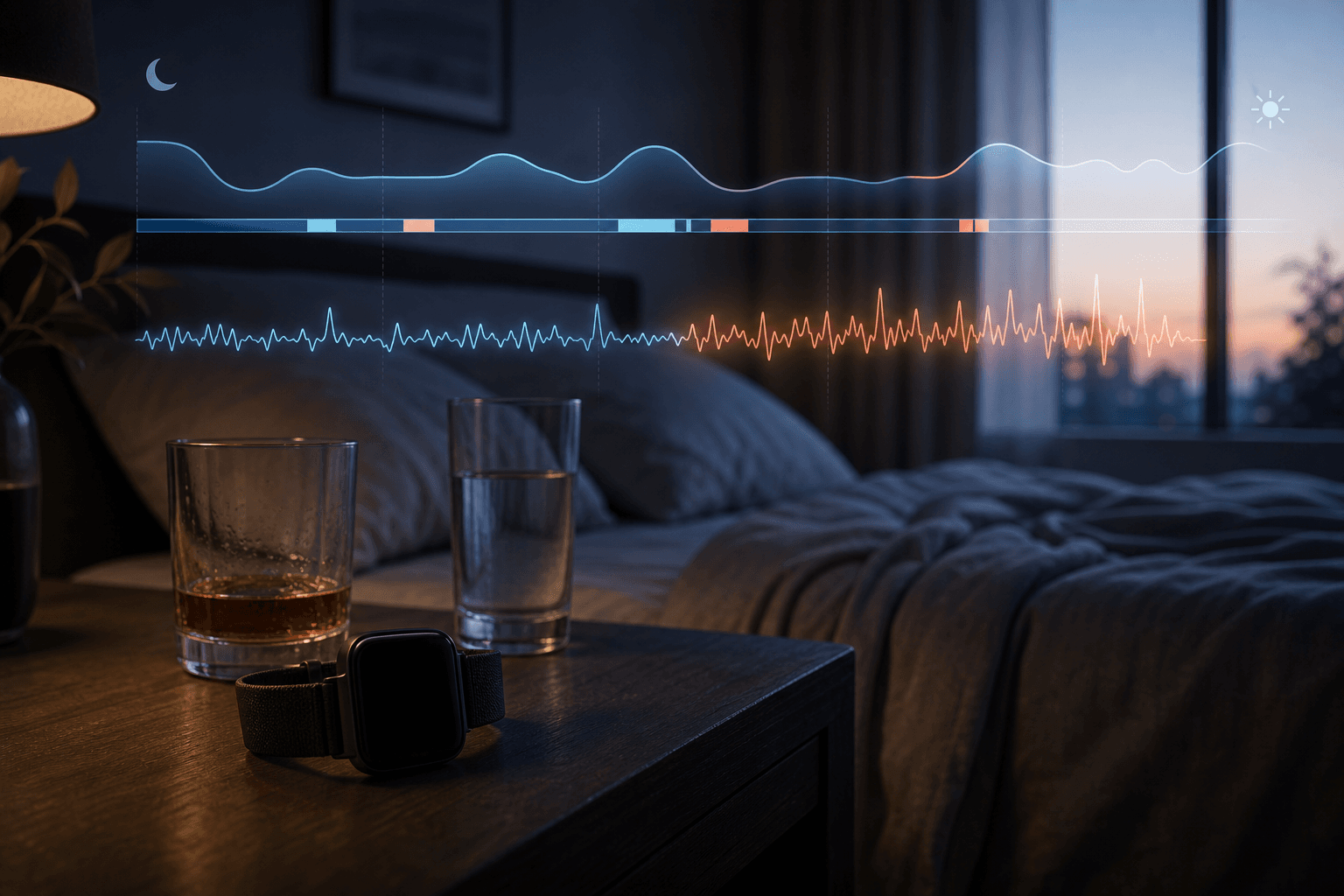
Lower HRV together with higher nighttime heart rate and shorter or interrupted sleep fits temporary post-alcohol changes observed in research. The changes vary with amount and timing, individual characteristics, age, sex, health and measurement method. Do not assign the cause to alcohol from HRV alone; review your baseline, heart rate, sleep and how you feel on waking together.
Key points
- Experiments assigning alcohol amounts found increased nighttime heart rate and lower values for some HRV measures
- Large retrospective everyday-data studies found similar associations but cannot prove causation
- Apple uses SDNN while studies and other devices may use RMSSD, so the size of a fall is not directly comparable
- Review awakenings, total sleep and feeling rested, not just how quickly you fell asleep
- In the morning, check measurement timing, HRV, heart rate, sleep and symptoms
- HRV cannot establish a safe drinking amount, sobriety or fitness to drive
Studies observed lower HRV alongside higher heart rate
In an experiment, 26 healthy adults completed three nights with different alcohol amounts. After drinking before bed, heart rate increased and overall HRV decreased. The high-frequency component, reflecting faster breathing-associated beat-interval changes, also decreased. Effects differed with dose, time of night, sex and the measure studied, and were more noticeable at higher doses.
A 2026 real-world study examined about 5.1 million days of records from 20,968 people. On days when individuals drank more than their usual amount, sleeping resting heart rate tended to be higher, HRV lower, sleep shorter and next-day activity reduced.
This was an observational study comparing existing daily records, not an experiment assigning alcohol. It used WHOOP users’ self-reports and retrospective commercial wearable data. HRV was RMSSD, not Apple’s SDNN. Company funding and author conflicts of interest were disclosed. A large sample cannot fully separate alcohol from accompanying changes in late nights, meals, behaviour or health.
Heart activity changes while the body processes alcohol
Even during sleep, the body continues to absorb and break down alcohol. Japan’s Ministry of Health, Labour and Welfare describes liver metabolism through acetaldehyde, a harmful intermediate, followed by further breakdown. Effects vary with individual characteristics, age, sex, amount consumed and health that day.
Experiments comparing drinking and non-drinking nights found changes in nighttime heart rate, blood pressure regulation and HRV. As heart rate rises, intervals between beats shorten. Heart rate partly influences HRV, but HRV is not simply the inverse of heart rate, so review them separately.
A fall in HRV does not show that sympathetic activity rose by a particular percentage or that the parasympathetic system stopped. Current HRV guidelines also caution against interpreting HRV as a direct measure of sympathetic activity or sympathovagal balance.
Falling asleep sooner can still mean waking later in the night
Alcohol can make it feel easier to fall asleep. Japan’s sleep guidance describes temporarily easier sleep onset and more deep sleep early in the night, with poorer sleep later. More alcohol may also increase nighttime awakenings.
In an experiment involving 30 people over three consecutive nights, pre-sleep alcohol changed the progression of sleep stages early in the night and reduced REM sleep. Amounts, timing and participants differ between studies, though. Not every stage changes the same way every time.
Apple Watch sleep stages are estimates based on sensors and algorithms, not direct brain-wave measurements. In the morning, do not focus only on how many minutes of deep sleep were lost. Prioritise total sleep, time awake during the night, bedtime, waking time and feeling rested.
Repeated use of alcohol as a sleep aid can lead to tolerance, where the same amount has less effect, or dependence, where stopping becomes difficult. Drinking to sleep is not a recommended sleep strategy.
Do not directly compare Apple Watch HRV with research measures
Apple Watch automatically measures when movement is sufficiently low and usable signals are available. HealthKit stores SDNN. These may be samples from several moments in the night rather than one continuous overnight recording using the same method.
Alcohol research may calculate several HRV measures from continuous ECG. Other wearables produce a representative overnight RMSSD. A study’s average reduction cannot simply be applied to one Apple reading or a daily average.
After drinking, bedtime, movement, heart rate, skin blood flow and sleep duration may also differ. If one day’s samples come from early night and another’s from dawn, differences in measurement timing become part of the difference between daily averages.
Five steps the next morning
Check measurement conditions
Open individual HRV samples and check times, devices and sample count. Do not mix sleep with daytime data, or SDNN with RMSSD.
Check heart rate
Review how sleeping or resting heart rate differs from your usual range. Even when lower HRV and higher heart rate coincide, do not assume the cause.
Look at sleep in separate parts
Check total sleep, prolonged awakenings, bedtime, waking time and feeling rested. Do not judge by one sleep stage.
Record what happened the previous evening
Alongside alcohol amount and the time you finished drinking, note late meals, staying up, exercise, fever, pain, medication and other simultaneous changes.
See whether the pattern returns over the following days
If you have no symptoms, review whether your usual pattern returns using the same device and similar conditions. You do not need more alcohol or extreme exercise to compensate for a low reading.
You do not need to drink more to investigate
Do not deliberately increase drinking to test its effect on HRV. If you already have drinking days, record the same items as on non-drinking days and review repeated patterns.
“One beer” can mean different quantities depending on product and container. Japan’s Ministry of Health, Labour and Welfare gives pure alcohol in grams as volume in mL × alcohol percentage ÷ 100 × 0.8. Where possible, recording pure alcohol amount and finishing time, rather than glass count alone, makes comparison easier.
These records cannot establish a safe personal upper limit. Unchanged HRV does not mean there is no risk of accidents, impaired judgement or long-term harm.
Put alcohol safety ahead of HRV
HRV, heart rate and sleep scores cannot tell you whether you are sober or fit to drive. In Japan, driving under the influence and drinking below age 20 are prohibited by law. People who are pregnant, breastfeeding or unable to tolerate alcohol should avoid it. There is also no basis for encouraging someone who does not drink to start for health or HRV.
Japanese Ministry guidance lists heavy drinking over a short period, drinking for sleep or anxiety, drinking during illness or after medication, and exercising or bathing during or after drinking among behaviours to avoid. Ask your clinician or pharmacist about alcohol with medication.
If nightly drinking for sleep continues and you cannot reduce it, or reduction brings marked insomnia or other difficulties, consult a healthcare professional or local public health or mental health service.
Clouded consciousness, poor responsiveness, repeated vomiting or abnormal breathing after drinking may indicate alcohol poisoning. Do not wait while checking HRV; contact emergency services, such as 119 in Japan or the appropriate local number.
References
- Sleep Guide for Health Promotion 2023 — Japan’s Ministry of Health, Labour and Welfare
- Guidelines on Alcohol Consumption and Health — Japan’s Ministry of Health, Labour and Welfare
- Impact of evening alcohol consumption on nocturnal autonomic and cardiovascular function in adult men and women — Sleep
- Altered sleep architecture following consecutive nights of presleep alcohol — Sleep
- Real-world effects of alcohol on heart rate, sleep, and physical activity by age and sex — PLOS Digital Health
- Guidelines for rigor and reproducibility of heart rate variability within human cardiovascular research — American Journal of Physiology-Heart and Circulatory Physiology
- Using Apple Watch to Measure Heart Rate, Calorimetry, and Activity — Apple
More in the Feelmo guide
Understand the basics of HRVUnderstand your sleep recordsExplore your own patterns